Ricard: the story of the young artist who turned an aperitif into a French classic
Discover the story of Ricard, the pastis created in 1932 by Paul Ricard: a story of art, marketing, restrictions, merchandising and popular culture.
Some brands can be explained by a recipe. Others by a logo. Ricard is best understood through the story of its creator: Paul Ricard, a young man from Marseille, born in 1909, who first dreamed of becoming a painter.
His father, a wine merchant, had a more practical view of life. He advised him to earn a living first and leave art for later. Paul Ricard followed that path, but in his own way. He did not become a painter in the classical sense, yet he applied his artistic eye to everything surrounding his brand: the label, the colours, the posters, the promotional objects and the way a product could become instantly recognisable.
Perhaps that is where the story of Ricard truly begins. Not only in a blend of anise and aromatic plants, but in an idea that was very modern for its time: a drink could also be an image, a gesture and a world of its own.
From the gap left by absinthe to the birth of pastis
To understand Ricard, we need to go back to the early twentieth century. Absinthe, long popular in France, was banned in 1915. At the time, it carried a dark reputation, associated with excess and supposedly dangerous effects. Its disappearance left room for anise-flavoured drinks.
Paul Ricard saw the opportunity. He experimented, searched for the right balance and worked with anise, liquorice, fennel and aromatic plants. In 1932, he launched his product with a direct slogan: “Ricard, le vrai pastis de Marseille”, meaning “Ricard, the true pastis of Marseille”. Ricard still officially highlights its 1932 origin and its identity as a Marseille pastis.
The word pastis also matters. It refers to the idea of mixture, with Provençal and Italian roots. It was a simple, popular and memorable name. Paul Ricard did not simply market a drink: he helped establish a word, a category and almost a new way of naming the anise aperitif.
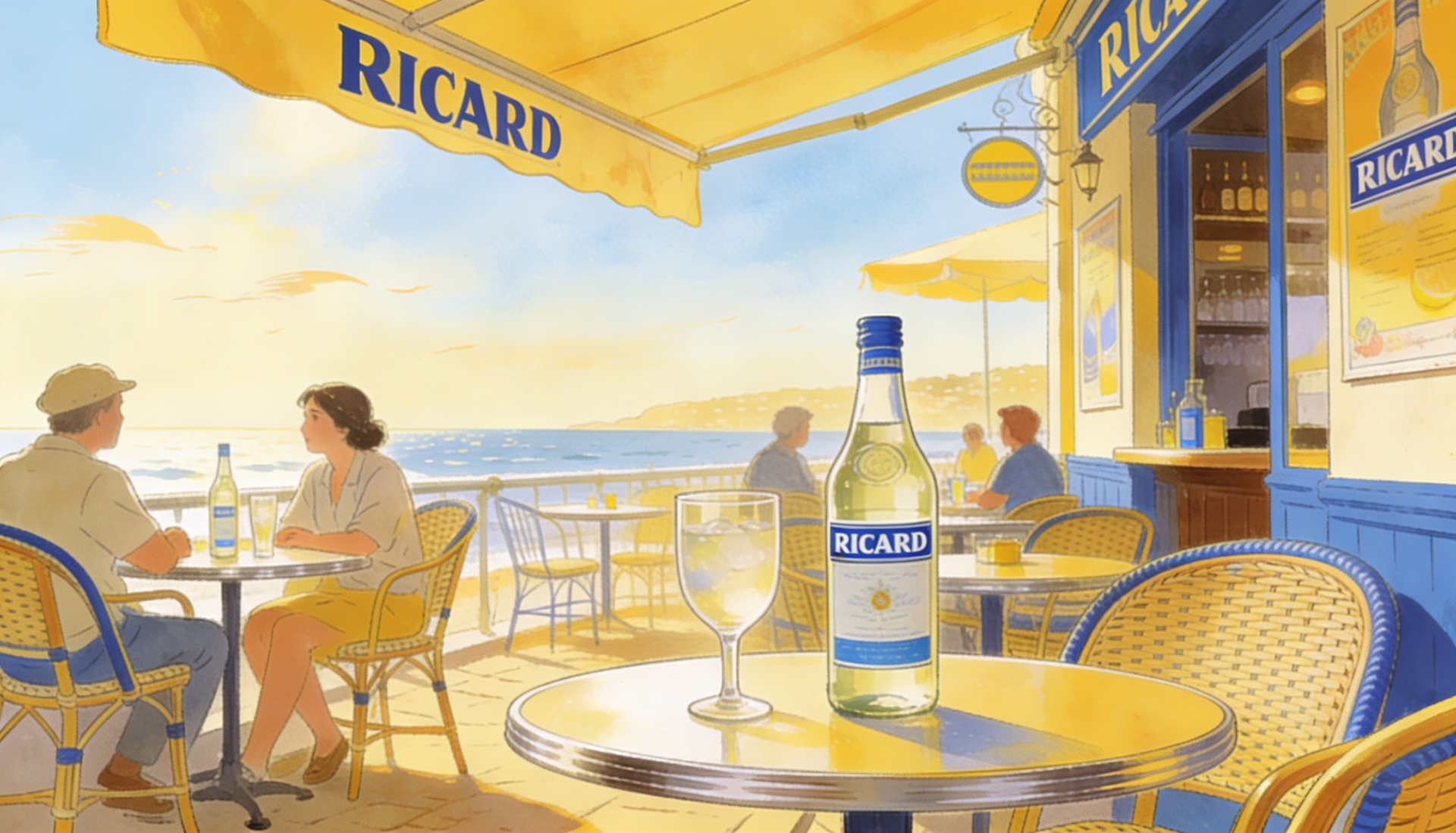
The way it is served also contributed to that identity. When water is added, the golden liquid turns cloudy, almost milky. This phenomenon is known as the louche effect, or ouzo effect. It is caused by the essential oils of anise, which no longer remain fully dissolved when the alcohol content drops.
But for the consumer, it is not just chemistry. It is a small ceremony. Ricard is not simply poured: it is prepared. And that is where, without overdoing it, the image of southern France appears: a glass, fresh water, a pause before a meal, a conversation slowly beginning and the feeling that time has eased its pace for a moment.
A brand that learned how to stay visible
The rest of the story was not straightforward. During the Second World War, under the Vichy regime, pastis was banned. For a still young company, it could have been a decisive blow.
Paul Ricard, however, did not simply wait. Several biographical accounts mention his retreat to the Camargue, his experiments and the production of a fuel substitute made from fruit, intended to help the French Resistance. Beyond the anecdote itself, the episode fits his character: someone able to adapt, work around obstacles and turn restrictions into action.
After the war, Ricard regained its place. But later, another challenge appeared: alcohol advertising became increasingly regulated. Once again, the brand looked for alternative ways to remain present.
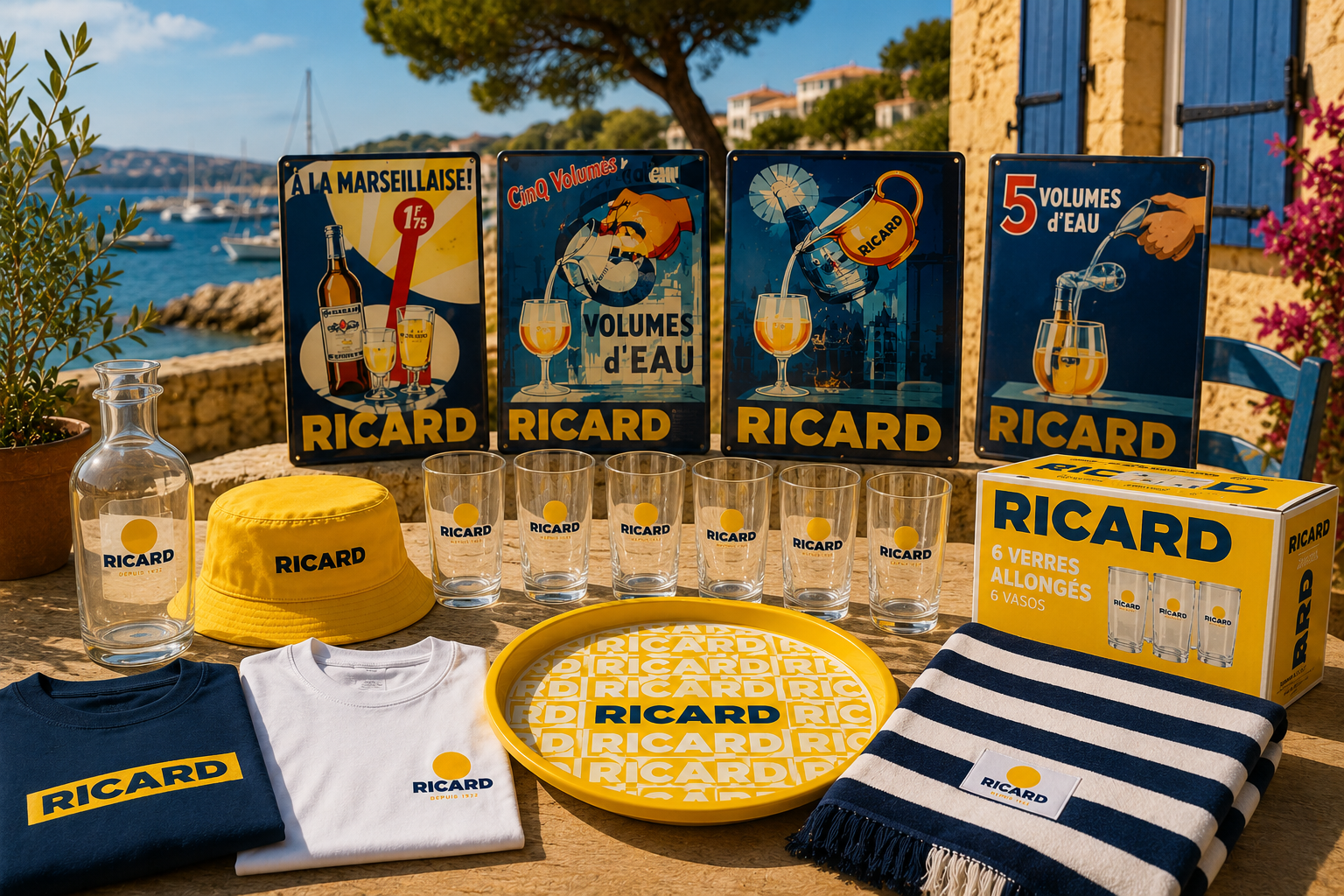
One of the most effective was merchandising. Ricard understood that a brand could be present everywhere without depending only on traditional advertising. Glasses, jugs, ashtrays, trays, parasols, posters and bar objects became memory supports. Many people did not only recognise the bottle: they associated Ricard with its glass, its colours and the objects that had long formed part of the everyday landscape of cafés and bars.
Ricard’s official website still highlights its collector objects, glasses and bottles, showing how central this dimension remains to the brand’s identity.
The other major example of this presence strategy was the Circuit Paul Ricard, in Le Castellet. Created by Paul Ricard and opened on 19 April 1970, it became one of the most modern racing circuits of its time. Its name appeared in newspapers, sports broadcasts and Formula 1 conversations. It was not conventional advertising, but it kept the Ricard name alive in public space.
In 1975, Ricard and Pernod, long-standing competitors in the world of anise-flavoured drinks, merged to create Pernod Ricard. Even as part of a large group, Ricard kept its own identity, closely linked to its founder, its visual universe and recognisable drinking habits.
And that strength remains very real. In 2025, according to the NielsenIQ ranking published by RTL, the 1-litre bottle of Ricard appeared as the second most purchased product by value in French supermarkets, behind Cristaline.
That is what makes Ricard’s story interesting: it is not only about an old aperitif. It is about how a brand can cross almost a century while remaining clear, popular and recognisable.
Paul Ricard wanted to be an artist. He may not have painted the canvases he once imagined as a young man. But he left behind a different kind of work: a complete brand, embedded in collective memory.
Drink responsibly.